Teaching, to me, is another way of learning. Learning inspires my teaching and teaching has inspired me to continue to learn. Learning requires time and continuous effort. It can be challenging but enjoyable. Growing up, I did not always find joy in learning but dance completely changed my perspective. For the first time, learning became fun and I was motivated to learn more. I approach teaching with an intention to find joy in learning and in the classroom. There are three principles that I engage with and emphasize in my teaching.
Building “our class” with my students
On the first day, I tell the students that this is not my class, it’s our class. I explain that our learning happens in two ways: we can all learn from each other, not just from me. I ask for their input and feedback throughout the class because I value their voices. It is crucial for me to remind them that our classroom is a safe place for them to advocate for themselves and to listen to each other. Cultivating the classroom to be a space of support, respect, patience, and generosity starts from me, the teacher, but I need my students to contribute to make it complete. My approach in building our class with my students is to build connections.
Our means our connection and to me, connection is illustrated by a circle. The use of a circle in the classroom is something I have been actively doing for many years. The majority of classroom conversations are held in a circle and I often facilitate a warm up in a circle. When we use a circle in a dance class, not only do we look one another in the eye, but we also see each other’s bodies as everyone sees their own body; no one is hidden behind another. There is no back of the studio and no symbols of hierarchy. When everyone moves together in a circle, our movements influence each other, and individual movement becomes a collective movement. The circle enables us to cultivate the classroom to be welcoming to whomever is in the class, so that we can build trust, be creative and engage in reciprocal learning.
In teaching dance technique classes with different experience levels, I found that the use of a circle is highly effective in building an inclusive environment where students can openly learn, attempt, and practice. I have observed that this led to a more supportive environment that was less judgmental and a fun, yet rigorous learning space. Additionally, I use peer to peer engagement where students work with their peers to review the class materials to practice together and ask questions of each other which enhances the collaborative approach.
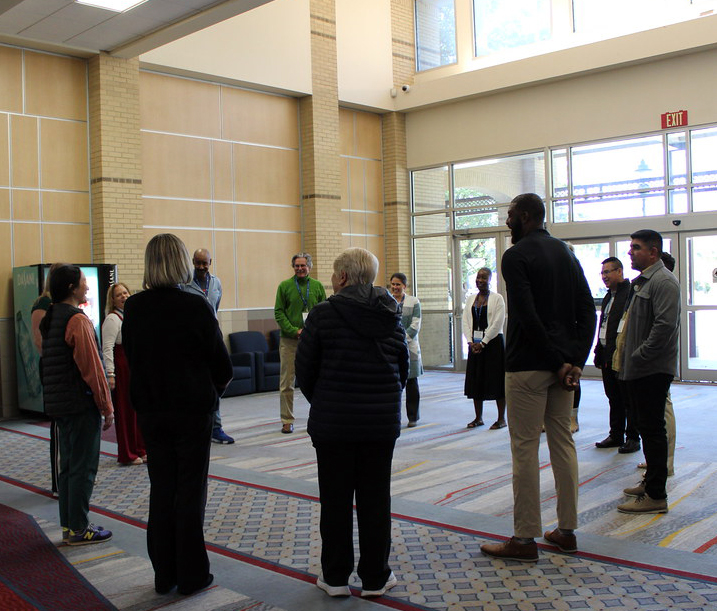 Photo by Monique Sempertegui
A welcoming and safe environment for a collaborative classroom
A classroom is a place where both students and teachers gather together to learn and discover. It is also a space for collaboration. To me, fostering a welcoming and safe environment is the most important ingredient in creating a collaborative classroom. For this purpose, I emphasize that we, as a class, become acquainted with each other to build trust and communicate with honesty and respect.
To build trust, we need to get to know each other. I ask my students how they are doing, how their bodies are, how their day was, what they are working on from other classes and so forth. My goal is to get to know them beyond just their names - to know more about who they are, what their needs are from their perspective, and what they enjoy outside of class. I believe it is essential that students feel comfortable studying with their classmates and me. This helps the class to have a more engaging learning and teaching experience, and enables us to share observations and feedback in a more honest way. Additionally, as a teacher, this helped me to try new approaches, to ask for their input and express myself more openly.
Over two decades of teaching, I have observed that whether it is a dance technique, choreography or seminar class, the students are more willing to try new directions, ask questions, step out of their comfort zone and share their opinions when they feel a sense of belonging, welcome and safety.
I believe that candid communication is necessary in a collaborative classroom. It involves suggesting ideas, sharing individual viewpoints, conflict resolution, and listening. When it comes to class discussion, I often assign the students to work in small groups, which was a piece of feedback that I received from students in the past. When I was an international student speaking up in class was one of the hardest things I had to overcome. I found that talking to a small group felt easier (and less embarrassing) than a big group. I had to trust my classmates that they would not judge how I spoke or when I misinterpreted them. I also encourage students to find a partner that they haven’t worked with previously. This forces them to interact and work with all their classmates rather than break down into small cliques.
In teaching a choreography or composition class where students produce a new work, having continual feedback sessions throughout the semester is vital. However, facilitating feedback sessions is not an easy task as a class and it is important how we approach it. I have observed that when students share with honesty and respect, it becomes attainable as a class. I have also learned that when facilitating sessions this way with my students, we are able to come to a collective decision on the session structure and our individual responsibilities.
The classroom as a playground
Over the last few years, I have been developing the idea of the classroom as a playground and ways to approach this academically. A playground is a place of creativity, whimsy, diversion, exuberance and social interaction. It is also accessible and welcoming. When I implemented this idea, I noticed an increase in students’ willingness and curiosity. Students were motivated to problem solve with their classmates, and the classroom became a safe space. Additionally, this affected the class attendance overall. I had many students who said that this is the only class that they did not want to miss. As a teacher, this meant a lot to me.
This idea of a playground has been very beneficial and effective when engaging with a diverse student body. There is a sense of ease when the class gets to adapt the idea of play based on the subject of a class or while completing assignments. There is a sense of acceptance when the class trusts each other and collaborates. A sense of community is fostered when the class cultivates critical thinking skills together. Furthermore, I found that applying a playground in dance improvisation or choreography classes was instrumental as it enhanced creativity and openness. The purpose of implementing a playground in my teaching is to learn, play and reflect together.
I expand this playground to include the rehearsal space when creating a new work with students from a variety of experience levels and backgrounds. My creative process centers on improvisation and experimentation. I encourage performers to engage in movement practice to connect with themselves and their surroundings while discovering what inspires them and their relational connections to each other. Their discoveries, such as bodily movements, imagery and stories become our ideas and inspiration. Then we subsequently experiment and contextualize to transform and assemble this into a new work. I am always interested in how one’s lived experiences manifest in the body and bodily movements and in highlighting individual stories while creating a collective story.